Losing Control to Gain Control
The autumn day was winding down, one of the last pleasant float trips on the Tuckasegee this past fall. The warm day had given way to cooler temps and winds, signaling the approach of an Arctic blast later that evening. The air was dotted with Midges and blue-winged olive mayflies, or BWOs. I hadn’t seen any trout eating the insects until we reached a large pool.
There was a line of trout stacked up feeding on the surface. I saw one large one, possibly an 18” brown take a fly off the surface. The light was low, so I tied a large midge emerger, size 18, with a size 22 midge pupa dropper on 5x tippet. The trout weren’t having any of the oversized flies and tippets, even though the client was making great casts and getting a good drift over the trout. After several fruitless drifts, I decided to switch flies. The insects were small, and I wasn’t sure which they were eating, so I rigged a Size 22 Griffiths gnat with a BWO wet fly size 24 as a dropper.
The switch worked. On the first cast, a trout took the BWO wet. Mark is a wonderful caster, one of the best, but tends to get excited and over-set the rod when a fish eats his fly. This was no exception. The tiny hook pulled out.
I said, “Mark, sometimes you have to lose control to gain control.” The philosophy was returned with a perplexed look. His wife chimed in with, “Sage advice, grasshopper.”
I explained to him that sometimes you have to “give” with the hook set to lessen the shock force of the take. I reminded him of the slip set, a process of letting go of the line while you set the rod.
It worked, well, sort of. On the very next cast, the large brown inhaled the Griffins Gnat with a big flush. I saw Mark raise the rod, I heard the beautiful sound of the line pulling off the Hardy reel…then quiet followed by the sound of the line flying back at us. Losing control to gain control also applies to playing a trout, not just setting the hook. It was heartbreak on a couple of levels. One, we lost the big one, and two, the hatch ended before I could rerig the setup. That fish would have to wait for another day.
The Mindset of Losing Control
Fly fishing for trout is unique in some ways. It is one of the few types of angling where one is trying to imitate a food source on a size 22 or smaller hook. Using a small hook can necessitate light tippets. I have used tippet down to a size 8x, but typically anglers are using 6x or 7x tippet. Trout Hunter, an excellent tippet, has a breaking strength of 1.8 lbs for 7x tippet. Not much to work with there, but necessary when the trout are eating small insects. The angler must learn how to reduce forces on the system, a.k.a., losing control.
Losing control to gain control is the art of “giving” when the trout is pressuring the system, and getting it back when the trout can’t resist. This is all about knowing when to give line and strip in line. Force is an interaction between two objects: your line and the trout. If you pull on the line while the trout pulls on the line, the forces can spike higher than the system can hold. I have seen tippet part ways, and even hooks straighten out when the angler pulls at the wrong time. That’s not to say you don’t want some pressure on the trout. You need to steer the trout where you want it to go and prevent it from throwing the hook, but you need to maintain forces below the breaking threshold of the tippet.
To do this, give line when the trout pulls harder. Mentally, many anglers find this hard to do; they feel they need to control the trout to land it. But by giving line when the trout pulls, you keep them on the line, and you can gain control as they tire out.
There are two critical times when an angler needs to lose control: on the hook set and when the trout makes a run. The hook set can produce a high shock force on the system, you’re pulling, but the fly is so small that it only goes in a few millimeters. Small hooks go in easily, but pull out easily too. It is easy to set with too much force, pulling the hook out. Also, if a trout makes a run. A run is when the trout decides to visit the next county, usually a straight downstream or upstream bolt. Two ways for dealing with these situations are the slip set and hold position.
The Slip Set
The most common form of hook setting on trout is the anchor or rod set. One pinches the line against the cork handle to prevent the line from slipping out of the rod as it is snapped up. It provides a significant amount of force and works for most trout-size flies and distances. However, with small flies, 18 or smaller, or short distances, it can produce too much force and pull the hook out.
To make a slip set, when the trout takes the fly, release the line from your rod hand. One cradles the fly line in the line hand. I prefer to make a circle with my thumb and pointing finger, cradling the fly line. Next, sweep the rod tip downstream to improve the hooking angle. When fishing midge patterns or BWOs on or near the surface, I sweep the rod on a three-count. I time the sweep so the line tightens on three. This slower set gives the trout time to pull the fly under and usually, take it deeper into the mouth. Try it, you may find you get better hooks up this way. Finally, when the line tightens, I let it slip through the rod guides and even my line hand. I can easily pinch the line if needed; however, by not holding the line, I won’t overpower the hook set, and two, if the trout bolts, I just let the line go, keeping the forces low.
Steps
1. Release the line from the rod hand
2. Sweep the rod to a three-count
3. Cradle the fly line with a circle created from your pointing finger and thumb of your line hand
4. Let the fly line slip through your line hand, be prepared to pinch the line to control it if needed.
If you have never done this set before, you will be surprised by how effective it is at getting solid hook-ups on small flies. You will need to practice it on the lawn a few dozen times before using it on the water. Once hooked up, you still need to play the trout on the light tippet.
Hold Position
Playing trout on light tippet isn’t about control; it's about encouraging the trout to do what you want and letting it wear itself out. An angler’s best friend is the hold position. This refers to where you position the rod after the hook set. Unlike lake or saltwater fishing, fishing with light tippet necessitates using the rod to absorb the forces. Trout will thrash and bolt, spiking forces that can exceed the breaking strength of the tippet. Having the rod in the correct position allows the tip of the rod to absorb those forces and protect the tippet.
After hooking the trout, one will want to position the rod 45° upstream and 45° up in the air. This 45/45 position does a few things. One, it will encourage the trout to move upstream. Trout will plane out against the pull of the rod. It’s like a keel on a sailboat, the rod angle is the sail, and the trout is the keel. The keel aligns with the sail. In this position, the rod functions as a shock absorber, keeping the force low on your tackle system. Once the trout moves even with you or upstream (even better), you can use the rod tip to control depth. Raise the rod tip if they are on the bottom, or lower it if they are near the surface and may start jumping.
While in this position, if the trout makes a run downstream, simply let go of the line with the rod hand or release the reel if it is on the reel while maintaining the hold position. You should hear the enjoyable sound of line peeling off the reel rather than the dreaded snap of the tippet parting ways with the trout. Once the trout stops, the rod position should encourage the trout to swim back upstream.
The hold position will also put the ever-so-important side pressure on the trout. Side pressure will force the trout to swim in the current. Tiring them out faster so you can get them into the net before the hook pulls, which will eventually happen with small hooks.
Spawning Brown Trout
A few weeks earlier, I was fishing on the Tuckasegee River. The water was low, and the trout were looking up. I had caught several brown trout on a caddis pattern early in the morning. However, like most fall days, the temperature warmed up, and the caddis took a break. I switch to an ant pattern, size 18 parachute pattern that I typically tie. I picked up a nice brown on the second cast. I started to work back downstream to head towards the car, fishing a nice run that had yielded 4 browns on the way up.
I was making a reach cast with the Thomas and Thomas Paradigm 3wt rod, an excellent dry fly rod, and one of my favorites. After the reach cast, I would feed out some line running the ant pattern downstream. I kept casting, working an area, then moving downstream a few steps until I reached the prime lie in the run. A small wave train in the fast water flattened out, signaling a drop off. I worked it thoroughly. On the fourth cast, a big trout rose and sucked the fly through the surface. It wasn’t a fast rise, but a powerful, committed take.
I set the rod by sweeping it to the right to improve the hooking angle. My finger was already off the fly line, and it peeled off the Ross reel. The fish turned and made a run downstream almost instantly. I swung the rod back to my left and positioned it in the 45/45 position, not daring to slow the trout down…it was big. The hefty trout finally stopped and turned upstream. I began reeling in to regain control and encourage the trout back upstream. I needed to get downstream of this one; I would need every advantage. However, it had different plans; it charged back upstream, forcing me to abandon the reel and start stripping line quickly. I even had to back up to keep tension on the line. Now the trout was more even with me, allowing for more control when the time came, but he wasn’t ready yet. He charged into some slack water near the bank, heading for some overhanging branches. Some of the branches reached into the water, and I was concerned he could get tangled.
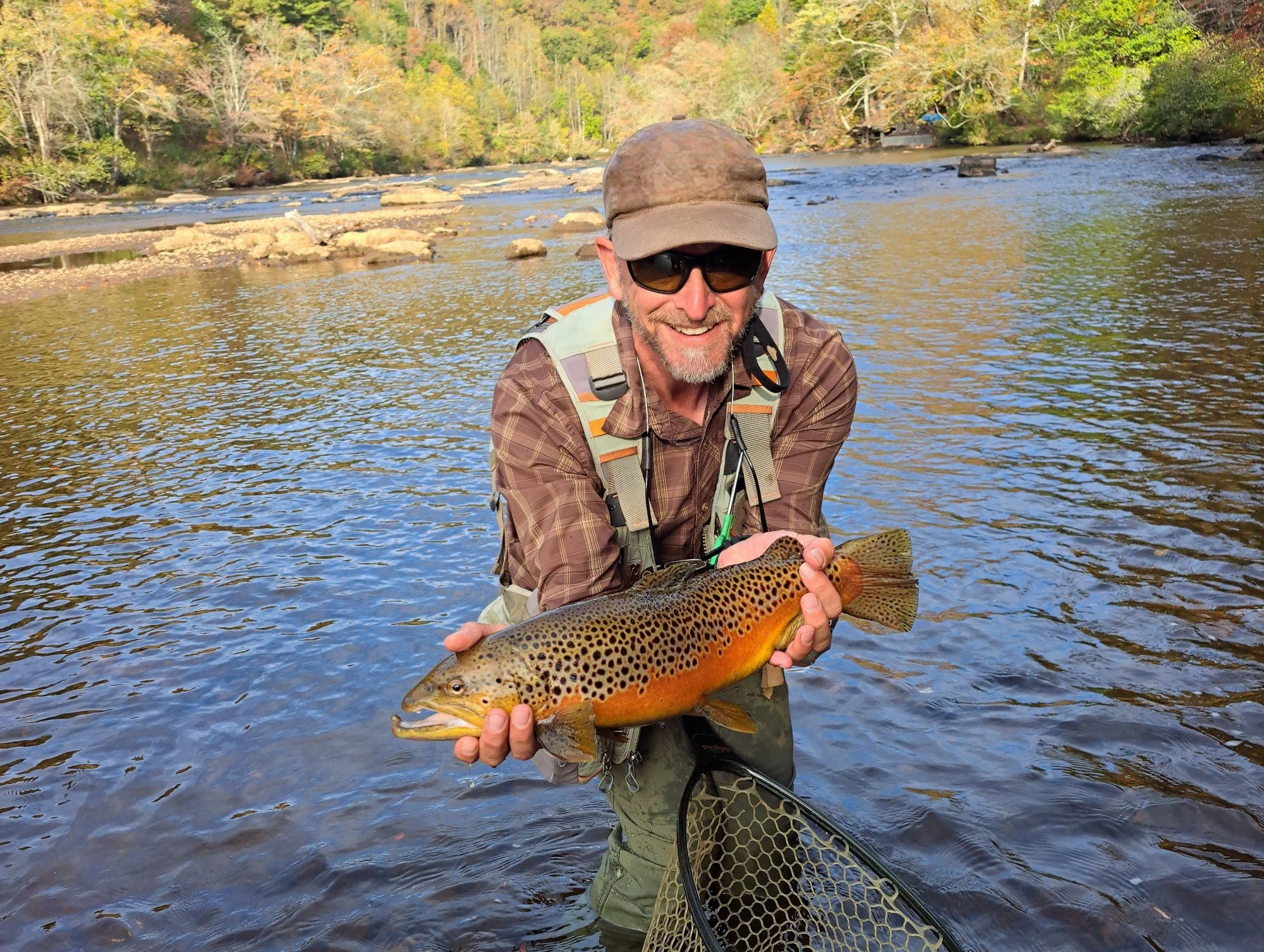
I changed the rod angle again, applying side pressure to keep him out of a tangle. He didn’t like that, so he changed directions again, heading into the current. I went back into the 45/45 position, putting lots of side pressure now. I also waded downstream, carefully maintaining the rod angle or position on the trout. It worked. I was now directly downstream of the monster and had an easy time scooping him into the net. In all, it took over 2 minutes to net the brown. It was a big male in full spawning colors.
Lesson Learned
Losing control early gave me control later. It is mentally hard to “give” with the trout. You want to make sure the hook bites and bring the trout in quickly, but that doesn’t always work. Losing control by using a slip set and positioning the rod in the 45/45 hold position, and letting the fish run seems counterproductive. But it is not. It is about keeping the forces low on your system, applying pressure at the right time, and knowing when to take control.
I didn’t over-set the hook and kept my finger off the line, letting the hefty trout have its way, at least early. Later, I put increasing amounts of pressure in the right direction and at the proper moments. Gradually, control shifted from the trout to me, and ultimately into the net.
By Patrick Weaver